Landlord Tax Deductions Checklist for Rental Property
This landlord tax deductions checklist covers the ordinary and necessary rental expenses US landlords usually deduct on Schedule E, plus the items that trip people up.
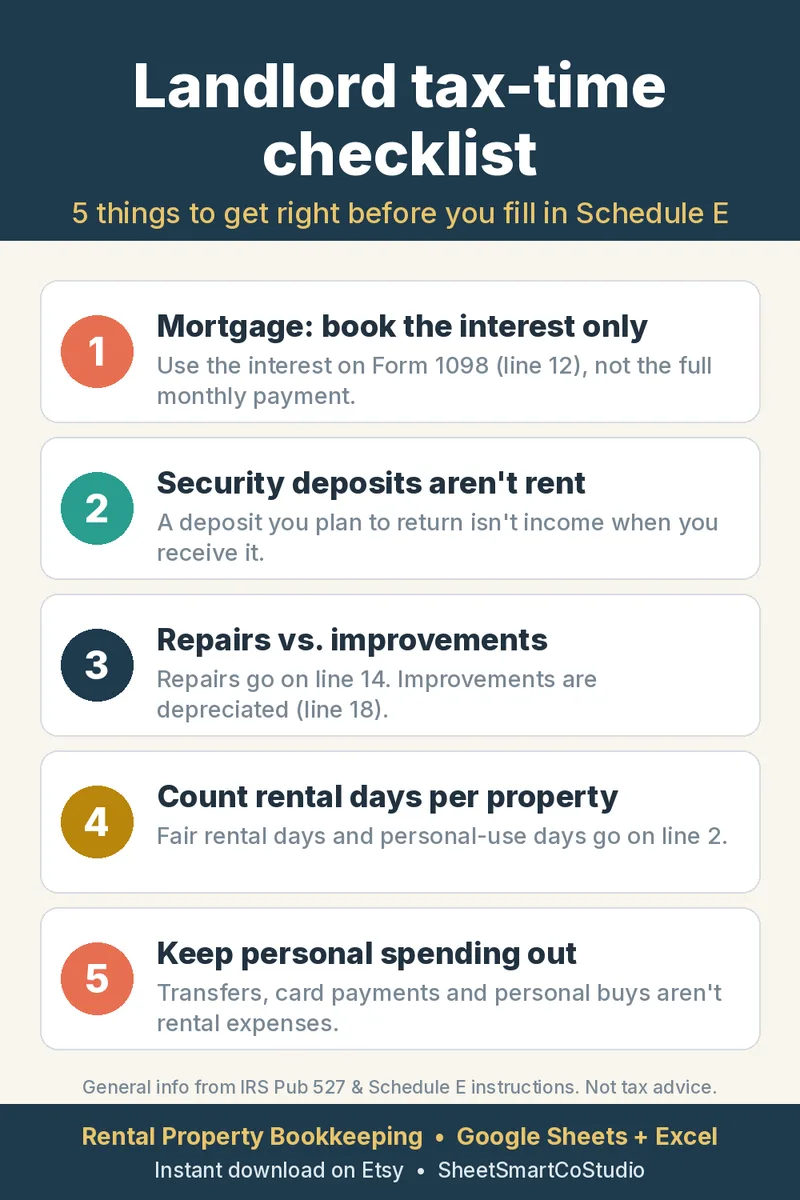
What expenses can you deduct on a rental property?
- Mortgage interest (Form 1098) and interest on other loans used for the rental
- Property taxes, including tax paid from your escrow account
- Insurance for the rental
- Repairs and maintenance, cleaning, lawn care, pest control
- Utilities you pay, supplies, advertising
- Management fees, leasing commissions, legal and professional fees
- Travel for the rental, such as driving to the property (keep a mileage log)
- Depreciation of the building (residential rental property is generally depreciated over 27.5 years) and of improvements
- Other: HOA dues, bank fees, licenses
Repairs vs improvements on rental property
A repair keeps the property in working order and is deducted in the year paid (line 14). An improvement makes it better, restores it, or adapts it to a new use, and is generally depreciated instead. Replacing a few shingles is a repair; a new roof is usually an improvement. The IRS has safe harbors, such as the de minimis safe harbor for lower-cost items; see IRS Publication 527 for the rules.
What you can't deduct
- Mortgage principal (explained here)
- The cost of land (it isn't depreciable)
- Your own labor
- Personal expenses, and the personal-use share of a property you also live in
Losses and the $25,000 allowance
Rental losses are generally passive. If you actively participate, you may be able to deduct up to $25,000 of rental losses against other income; that allowance phases out between $100,000 and $150,000 of modified adjusted gross income. Your tax software or preparer applies this on Form 8582.
Keep the checklist honest with good records
Deductions are only as good as your records. A monthly bookkeeping routine and a Schedule E worksheet make the checklist easy to fill.
See it on Etsy ($14.99, one-time)
FAQ
Can I deduct repairs on my rental property?
Yes. Ordinary repairs that keep the property in working condition are deducted in the year you pay them on Schedule E line 14. Improvements are generally depreciated instead.
Can I deduct my time spent fixing my rental?
No. You can deduct what you pay for materials and for other people's work, but not the value of your own labor.
Is depreciation required on rental property?
Depreciation is how you recover the building's cost. When you sell, the IRS treats depreciation you were allowed to take as taken, so most landlords claim it each year. Ask your tax professional.
Can I deduct travel to my rental property?
Ordinary and necessary travel for managing the rental, such as driving to collect rent or fix something, is generally deductible. Keep a mileage log.