Schedule E Expense Categories: The Full List (Lines 3–21) With Examples
The Schedule E expense categories are the 15 expense lines on Part I of IRS Schedule E (Form 1040), lines 5 through 19, plus the income lines 3 and 4 and the totals on lines 20 and 21.
Landlords report each rental property in its own column (A, B or C; use more pages for more properties). Here's every line with examples. Line names follow the current form; check the Schedule E instructions for your tax year.
Schedule E categories list
| Line | Category | Examples |
|---|---|---|
| 3 | Rents received | Rent, late fees, pet rent, advance rent, deposits you kept, tenant-paid expenses |
| 4 | Royalties received | Oil, gas, mineral, copyright royalties (not typical for landlords) |
| 5 | Advertising | Listing sites, signs, paid ads for vacancies |
| 6 | Auto and travel | Driving to the property for rental business (standard mileage rate or actual costs), travel to manage a property |
| 7 | Cleaning and maintenance | Turnover cleaning, lawn care, snow removal, pest control |
| 8 | Commissions | Leasing commissions paid to an agent |
| 9 | Insurance | Landlord / fire / liability insurance for the rental |
| 10 | Legal and other professional fees | Tax prep for the rental part, attorney fees for leases or evictions |
| 11 | Management fees | Property manager's monthly percentage |
| 12 | Mortgage interest paid to banks, etc. | Interest reported on Form 1098 (not principal) |
| 13 | Other interest | Interest on other loans used for the rental, e.g. a HELOC used for a roof |
| 14 | Repairs | Fixing what's broken: plumbing repair, patching drywall, replacing a broken window pane |
| 15 | Supplies | Smoke detectors, light bulbs, small items used for the rental |
| 16 | Taxes | Property tax on the rental (including escrowed tax your lender paid) |
| 17 | Utilities | Water, trash, gas, electric you pay for the rental |
| 18 | Depreciation expense or depletion | Yearly depreciation of the building and improvements (from Form 4562) |
| 19 | Other | HOA dues, bank fees, licenses, other ordinary and necessary costs (list them) |
| 20 | Total expenses | Add lines 5 through 19 |
| 21 | Income or (loss) | Line 3 + line 4 minus line 20 |
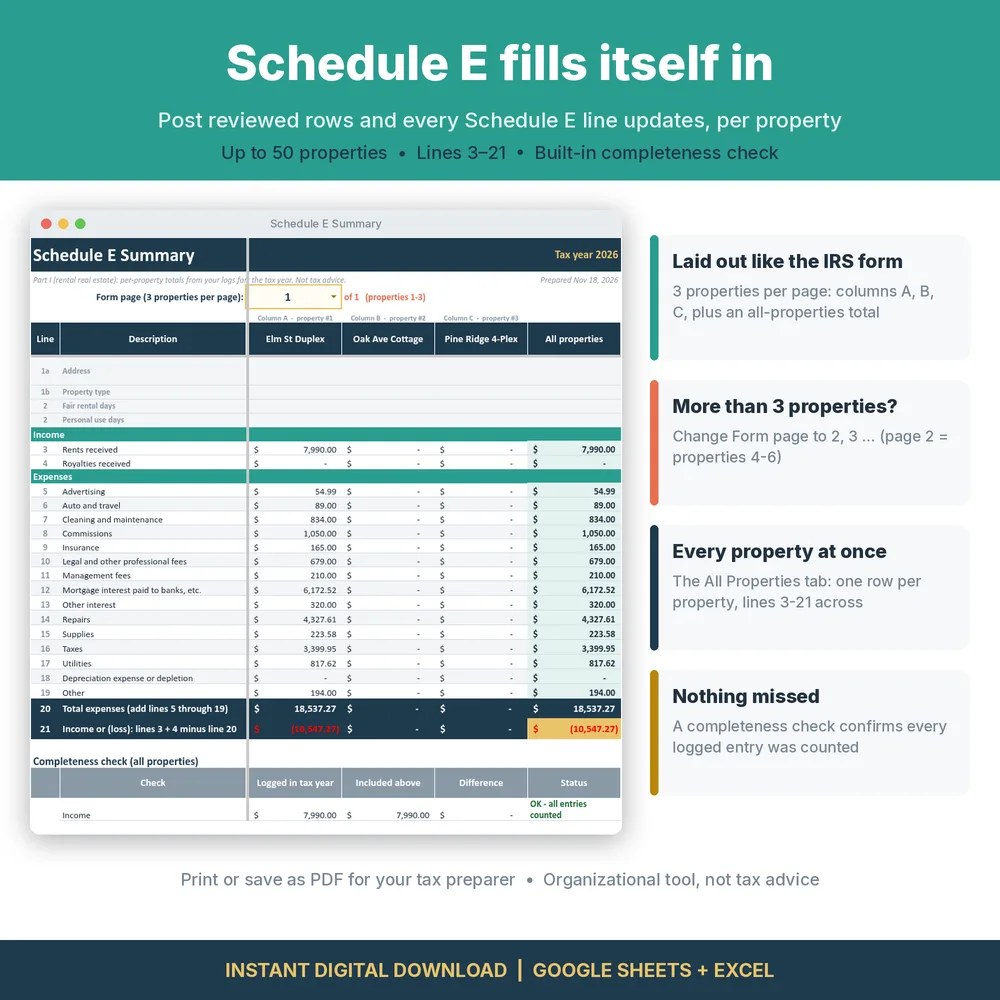
Lines 1 and 2: address, property type, and fair rental days
Line 1a is the property address and 1b the property type (single family, multi-family, vacation/short-term rental and so on). Line 2 asks for fair rental days and personal use days. If you used the place personally for more than the greater of 14 days or 10% of the days it was rented at a fair price, it's treated as a residence and your deductible expenses are limited (IRS Publication 527, chapter 5).
How to fill out Schedule E for rental property: common mistakes
- Putting the whole mortgage payment on line 12. Only the interest goes there; here's why.
- Expensing an improvement as a repair. A new roof is usually depreciated (line 18), not a line 14 repair; see the deductions checklist.
- Counting a refundable security deposit as rent; see security deposits.
- Forgetting expenses paid by card or in cash. A monthly routine (rental bookkeeping guide) fixes this.
See it on Etsy ($14.99, one-time)
FAQ
What are the Schedule E expense categories?
Advertising, auto and travel, cleaning and maintenance, commissions, insurance, legal and other professional fees, management fees, mortgage interest paid to banks, other interest, repairs, supplies, taxes, utilities, depreciation expense or depletion, and other (lines 5–19).
Where do HOA fees go on Schedule E?
Most landlords report HOA dues on line 19, Other, and describe them. Check with your tax preparer for your situation.
What are fair rental days on Schedule E?
Days the property was rented at a fair rental price. Days rented to family below market rate generally count as personal use days instead.
How many properties fit on one Schedule E?
Each Schedule E page has columns A, B and C for three properties. Use additional Schedule E pages for more.