How to Do Bookkeeping for Rental Property (A Simple System for Landlords)
To do bookkeeping for rental property, record every dollar in and out of each rental, sort it into the IRS Schedule E categories, and keep proof, ideally once a month rather than in a panic in April.
That's it. Small landlords don't need double-entry accounting software to stay organized. Here's a routine that works for one duplex or for 50 doors.
Step 1: Give your rentals their own bank account
A separate checking account (and ideally a separate card) for your rentals is the single biggest time-saver. Every line on that statement is then a rental transaction, so sorting takes minutes instead of hours.
Step 2: Track rental property income and expenses every month
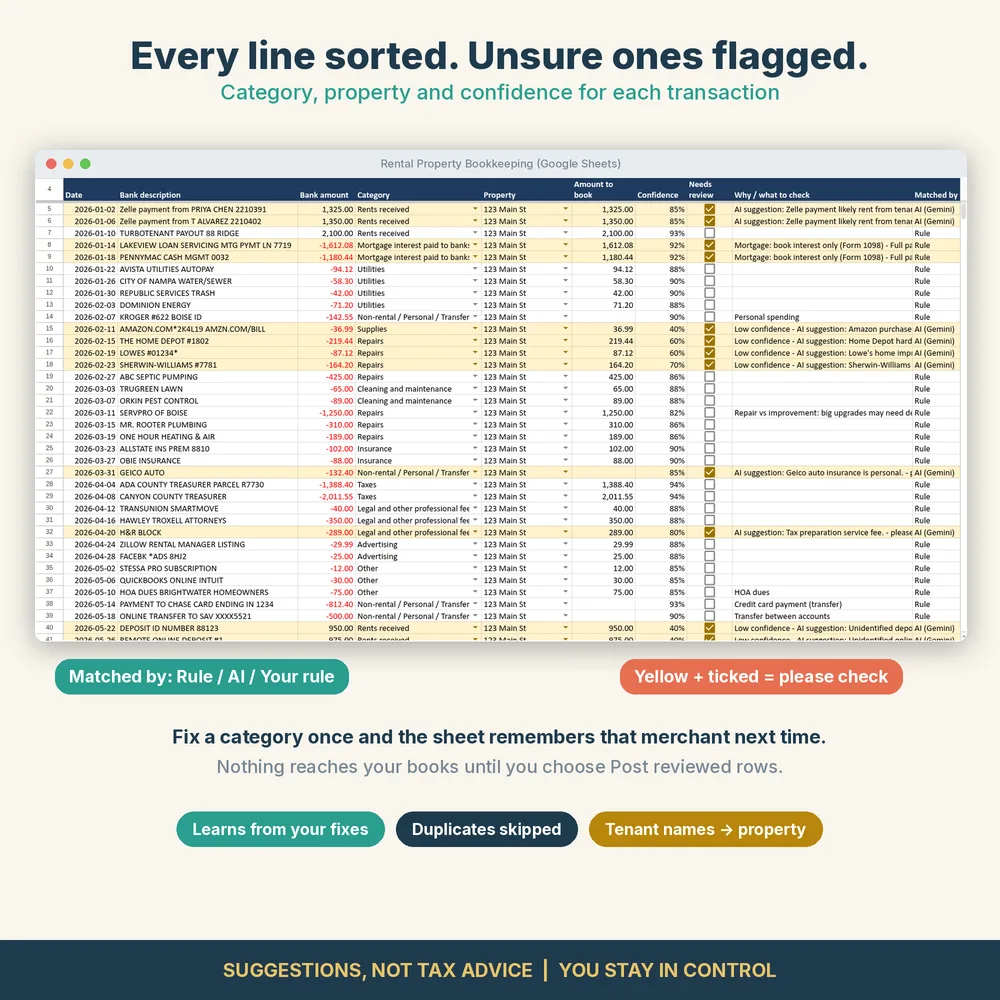
Once a month, download your statement and log each line: date, amount, property, and category. You can type it in, or import the bank's CSV or PDF into a spreadsheet (see how to import a bank statement into Google Sheets).
Step 3: Use the Schedule E categories from day one
If your categories match the tax form, year-end is just a sum. Use the line names: advertising, auto and travel, cleaning and maintenance, commissions, insurance, legal and professional fees, management fees, mortgage interest, other interest, repairs, supplies, taxes, utilities, depreciation, other. The full Schedule E category list has examples for each.
Step 4: Keep things out of your rental numbers that don't belong
- Mortgage principal. Only the interest is deductible; see can you deduct mortgage payments.
- Refundable security deposits. Usually not income when you receive them; see is a security deposit rental income.
- Transfers and credit card payments. Moving money between your own accounts isn't income or an expense. Log the card's individual purchases instead of the payment.
- Personal spending that slipped onto the rental card.
Step 5: Keep receipts and a rent roll
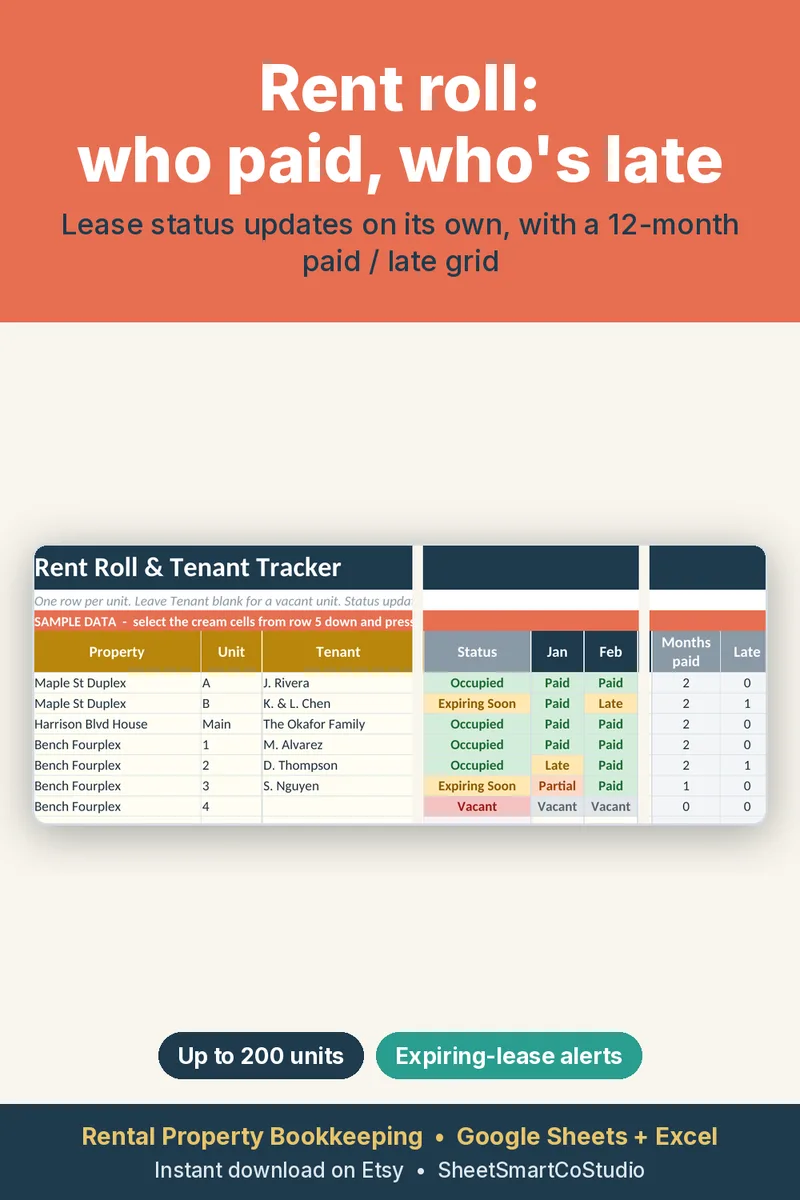
IRS Publication 527 explains which records to keep. Save receipts for repairs and improvements (a phone photo in a folder per property is fine), Form 1098 from your lender, insurance and property tax bills, and a rent roll showing each tenant, lease dates, rent and deposit held.
Step 6: Close the year with a Schedule E summary per property
At year-end, total each category per property. That table is what you (or your CPA) copy onto Schedule E lines 3–21. Our free Schedule E worksheet does the math for one property.
Software or spreadsheet?
Rental accounting apps are great if you want bank feeds and tenant portals and don't mind a subscription. A spreadsheet is cheaper, you own your data, and it's enough for most landlords with a handful of properties. The trade-off is that you do the monthly import yourself.
See it on Etsy ($14.99, one-time)
FAQ
What is the best way to track rental property income and expenses?
Use a separate bank account for your rentals, then log each month's transactions by property and Schedule E category in a spreadsheet or app. Doing it monthly keeps year-end to a quick summary.
Do I need accounting software for one rental property?
Not usually. A spreadsheet with income and expense logs that use the Schedule E categories, plus your receipts and Form 1098, covers what most single-property landlords need.
How long should landlords keep rental records?
Keep records that support your tax return for as long as the IRS can examine that return, generally at least 3 years, and keep property purchase and improvement records for as long as you own the property and for a period after you sell. See IRS Publication 583 and 527 for details.
Should rental income go in a separate bank account?
It isn't required, but it makes bookkeeping much easier and gives you a cleaner paper trail.